Back to All Projects
🧠 Federated Learning with Blockchain & IPFS
📌 Project Overview
This project integrates Federated Learning (FL) with Blockchain and IPFS to create a decentralized, auditable, and transparent AI training ecosystem. The system ensures that local data from different clients (e.g., stores, hospitals, IoT devices) remains private, while model updates are aggregated securely on a central node. Each aggregation round is recorded on the Ethereum blockchain for transparency, and the aggregated global model is stored on IPFS for decentralized access.
⚙️ System Architecture
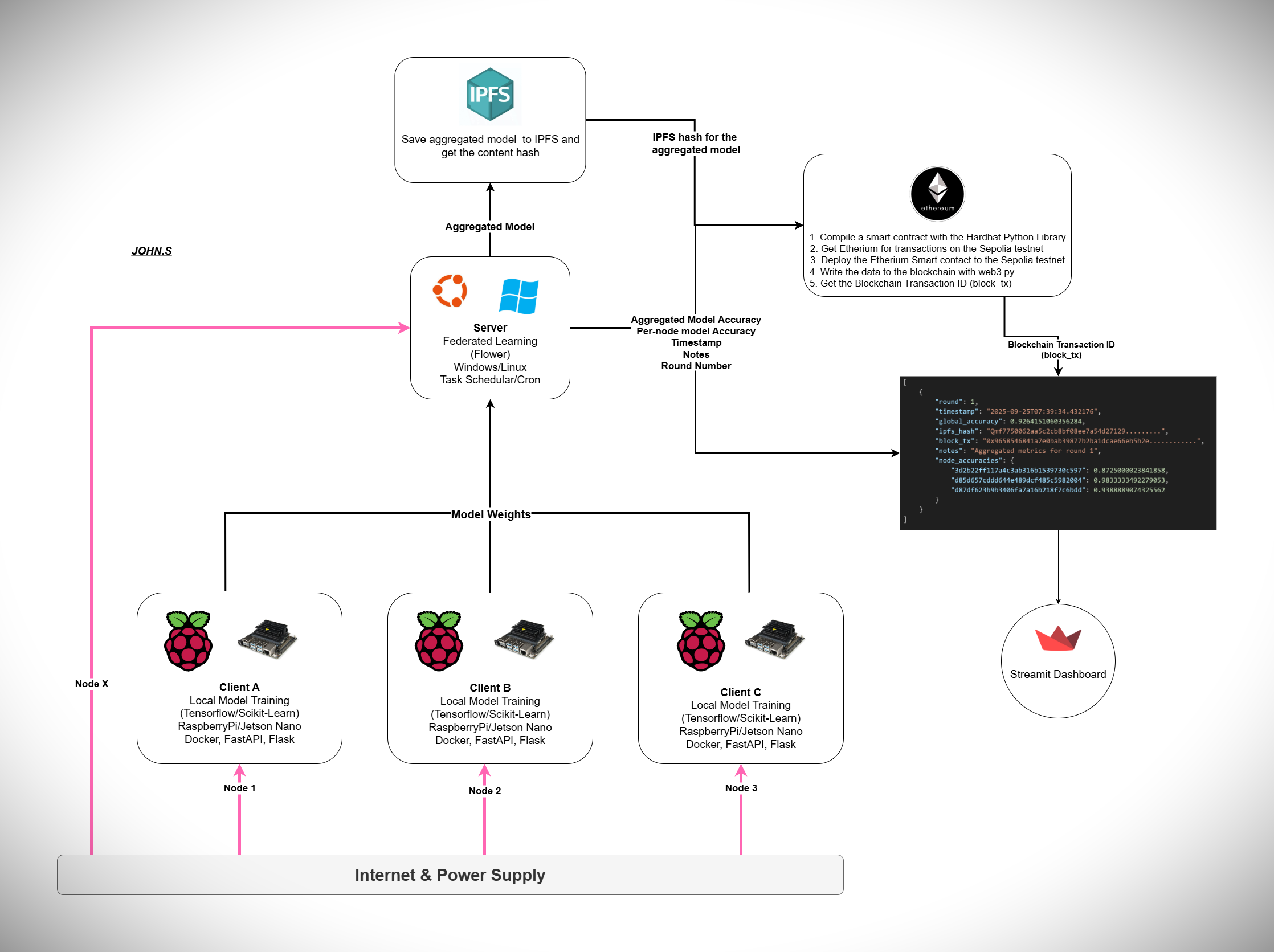
1. Clients (Local Nodes)
- Each client (Raspberry Pi or Jetson Nano device) trains a local ML/DL model using its private data.
- Frameworks used: TensorFlow, Scikit-learn, Docker, FastAPI, Flask.
- Example: Client A Prediction System (Store A)
2. Central Server (Aggregator Node)
- Runs Flower (FL framework) for model aggregation.
- OS: Windows/Linux.
- Automation via Task Scheduler / Cron jobs.
- Collects model weights, aggregates them, and produces a global model.
3. IPFS Storage
- The global model is saved to IPFS after each aggregation.
- An IPFS content hash is generated to ensure immutability and integrity.
4. Ethereum Blockchain Logging
- Each training round’s metadata (accuracy, timestamp, round number, IPFS hash) is recorded on the Ethereum Sepolia testnet.
- Example Transaction (Round 10): Sepolia Transaction on Etherscan
5. Dashboard & Visualization
- A Streamlit Dashboard visualizes metrics such as:
- Global accuracy trends
- Node-specific accuracy contributions
- Blockchain transaction logs
- URL: Federated System Dashboard
- 📊 Observation: Global accuracy improves with increased training rounds, showing the positive impact of collaboration.
📂 Data Flow Example
- Client A (Store A) submits input data to its prediction system.
- Local model predicts output and updates its parameters.
- Model weights are sent to the central aggregator (not raw data).
- Aggregator combines weights from all clients → generates a global model.
- Global model stored on IPFS + metadata logged to blockchain.
- Dashboard updates global accuracy & blockchain records.
- Improved model sent back to clients for further training → cycle continues.
🛠️ Frameworks & Tools Used
- Machine Learning: TensorFlow, Scikit-learn
- Federated Learning: Flower (FL framework)
- Web Apps (Client-side): FastAPI, Flask, Dockerized deployment
- Blockchain & Storage: Ethereum Sepolia testnet, Hardhat + Web3.py for smart contract & transactions, IPFS for decentralized model storage
- Dashboards: Streamlit (real-time monitoring)
- Hardware (Client Nodes): Raspberry Pi, NVIDIA Jetson Nano
🔗 Useful Links
Contact & Code Access
I am happy to discuss this project, answer any questions, or provide access to the source code for the client-server and blockchain components upon request. Please feel free to reach out to me.
Contact Me
📖 Documentation
🌟 Key Contributions of This System
- Data Privacy – Local training ensures raw data never leaves the client.
- Transparency – Blockchain records provide immutable proof of training rounds.
- Integrity – Models stored on IPFS with unique hashes for verification.
- Scalability – Supports multiple clients/nodes with lightweight devices.
- Improved Accuracy – Collaborative training boosts overall model performance.
Practical notes, risks and recommended practices
- Privacy: raw client data never leaves clients. Only model updates are transmitted.
- Availability: ensure IPFS pinning or cloud backup so model files remain retrievable.
- Key management: protect the private key used to sign blockchain transactions. Use environment secrets or hardware keys for production.
- Audit batching: to improve throughput, consider uploading and recording on-chain every N rounds (checkpointing) instead of every round.
- Monitoring: log times for local training, communication, aggregation, IPFS upload, and tx confirmation to measure rounds/minute and spot bottlenecks.
- Resilience: handle clients dropping out; strategy should tolerate missing updates and proceed when minimum clients respond.
Quick linear summary
- Clients train locally and produce weight updates.
- Clients send updates to the central aggregator.
- Aggregator performs FedAvg to create the global model.
- Aggregated model is saved to disk.
- Saved model is uploaded to IPFS → returns ipfs_hash.
- Aggregation metadata + ipfs_hash is recorded on the blockchain → returns block_tx.
- Ledger is updated and dashboard published.
- Clients fetch or receive the new global model → next round begins.
